We're living in a post-iPad age for PCs. Excellent battery life and
supremely portable forms sometimes make me ask: why use a laptop, which
has subpar battery life, at all? Why not just get things done on a
tablet instead?
The new MacBook Airs announced at WWDC
erase part of that question: the battery life in these new models is
astounding. They hit iPad territory, and blow away last year's
performance. So, Mac laptops with iPad-strength batteries, check. And lower prices, too? Check again.
Also a nice surprise: the 13-inch Air and 11-inch Air are more similar than ever, with the same exact new fourth-gen Intel Haswell processors, storage options, RAM, and upgraded 802.11ac Wi-Fi
capability. Which also means, other than the battery, in most ways
they're pretty much the same as before.
The biggest problems with last year's otherwise excellent little 11-inch Air were that the entry-level $999 model only came with a 64GB solid-state drive, and that
its 5-hour battery life was a compromise compared with the 7-plus hours
of the 13-inch.
This year, the $999 entry-level model has a 128GB
SSD, and the battery life's an awesome 10-plus hours. In its size class,
the 11-inch Air has become a seriously perfect little laptop...if you
can forgive its year-over-year sameness.
Sarah Tew/CNET
I'd
be lying if I didn't say I wish the new Airs had bigger,
better-resolution screens and more ports. Still, I'd give these up
gladly for better battery life and more storage any day of the week.
Unless you've got your heart set on a Retina Display, these new Airs are
worth considering for that battery life alone. I do feel these laptops
are a lot less exciting, in theory, but the debate of Apple and its
product inventiveness is a coffee-shop conversation for another time. In
practice, this Air has made practical improvements, and it's the
workhorse to beat...mainly because of that impressive battery.
For example, the Samsung Chromebook cost just £230 / US$330 / AU$320 at launch. There are exceptions, of course. Google's own Chromebook Pixel
is a gorgeous high-end notebook costing £1,050 / US$1,300 (around
AU$1,730), which is more than either of the two 11-inch MacBook Air
models in the mid-2013 refresh, but it proves cloud computers can be as
stylish and desirable as an Apple notebook. If you want an ultra-portable Windows 8 laptop, the Samsung Series 9 NP900X3D
has an Intel Core i5 processor and 128GB of flash storage like this
MacBook Air, but its screen is 13 inches, and we're testing the 11-inch
MacBook Air.
The Lenovo ThinkPad X1 Carbon Touch
is one of the thinnest and lightest Windows 8 netbooks on the market,
and a very credible alternative to the MacBook Air if you prefer Windows
to OS X.
Since the late 2010 MacBook Air refresh, Apple
has released four individual MacBook Air models with each generation.
The mid-2013 release is no exception. Once again we have two 11-inch
models and two 13-inch MacBook Airs. All use 1.3GHz dual-core Intel Core
i5 processors from Intel's new Haswell range. The
two 11-inch MacBook Airs have double the solid state storage of the
previous generation of MacBook Air, at 128GB for the cheaper model we
reviewed and 256GB for the more expensive 11-inch MacBook Air, up from
64GB and 128GB respectively. The 13-inch MacBook Airs retain their
predecessors' 128GB and 256GB of storage, but are a little cheaper.
Even with the new Haswell processors, gamers, video editors and other high-needs users might prefer the power offered by a MacBook Pro,
but the highly portable MacBook Air is perfect for students, business
travellers and just about anyone who appreciates its incredibly thin and
light design.
The 11-inch MacBook Air 2013 with 128GB
storage that we reviewed is the cheapest model in the range, priced at
£849 / US$999 / AU$1,099.
Design and features Swap someone's 2012 MacBook
Air with the 2013 model and he or she will never know the difference.
Cosmetically, it's identical to last year's version: same aluminum
unibody construction, same ports, same 1,366x768-pixel 11.6-inch
display, same keyboard and clickable trackpad.
Sarah Tew/CNET
Consider
that the MacBook Air is a laptop that's stayed largely unchanged (and
the 11-inch version feels identical to the one that debuted in 2010),
and you have what amounts to a pretty conservative computer update.
Sarah Tew/CNET
And
yet, the Air's still one of the best-feeling laptops, all-around, that
exists. Apple did its homework making the Air feel comfortable, and it's
paid off with a long shelf life. The glass multitouch trackpad's still
the most responsive out there, although the surface area on the 11-inch
Air is small and narrower, making four-finger gestures feel cramped. The
backlit keyboard's the same size and feel as on the 13-inch Air, and
still feels great, although the row of function keys are pretty shrunken
down.
Sarah Tew/CNET
The Air doesn't feel as wafer-thin, though. The Sony Vaio Pro 11 trumps the Air on size and weight (1.9 pounds),
compared with the relatively more beefy 2.3 pounds on Apple's
all-aluminum design. It still feels good to hold, but it's not
astonishing anymore. The 11-inch Air and the Sony Vaio Pro 11.
Sarah Tew/CNET
The
11.6-inch display feels too small for the Air's size, though. It's the
only 16:9 wide-screen display in Apple's laptop arsenal, but you could
have fit a larger screen in there -- the bezel's awfully wide. That's
because it really has the base of a 12-inch laptop, which is how it
accommodates such a large keyboard. Interestingly, the 11-inch Air's
screen and bezel have exactly the same height and bezel thickness as on
the 9.7-inch iPad. The Air's 16:9 screen is wider. The Vaio Pro 11 (right) has a smaller footprint than the 11-inch Air, and a 1080p display.
Sarah Tew/CNET
The
1,366x768-pixel-resolution display -- same as last year's -- is
admittedly very crisp and covered with a bit of antiglare coating. But
all you have to do is stare at your Retina iPad display to see what a richer, higher-res display
could look like. And many laptops now have higher resolutions: the Vaio
Pro 11 and Microsoft Surface Pro,
similarly sized (and priced) products, have 1,920x1,080-pixel
resolution packed into 11- and 10-inch displays. There isn't much of an
excuse this year.
Apple MacBook Air (11-inch, June 2013)
Video
DisplayPort/Thunderbolt
Audio
Stereo speakers, headphone jack
Data
2 USB 3.0
Networking
802.11ac Wi-Fi, Bluetooth
Optical drive
None
Specification
The 11-inch MacBook Air 2013's chassis is almost totally
unchanged from last year's model. The only difference is a second
microphone hole in the left-hand side, with the dual mic setup using
adaptive beam forming to reduce background noise. But there seems little
reason for Apple to change such a popular and practical design.
At
just 17mm (0.68 inches) at its thickest point and weighing just 1.08kg
(2.38lbs), it's so light and portable it's easy to forget it's in your
bag. It's sturdy too. If you lift it by the corner it doesn't creak and
flex like lesser, cheaper notebooks, and little luxuries such as the
multi-touch trackpad, backlit keyboard with ambient light sensor,
magnetic power plug, stereo speakers and the 720p FaceTime HD camera are
retained.
The changes to the 2013 11-inch MacBook Air
are all under the hood. The off-the-shelf processors are 1.3GHz dual
core Haswell Intel Core i5s, though you can upgrade it to a 1.7GHz
dual-core Intel Core i7 using the custom options on the online Apple
Store. Haswell
processors, the fourth generation of Intel's Core series, are designed
from the ground up to use significantly less power than before, without
compromising on performance. Indeed, their integrated Intel HD Graphics
5000 chipset gives up to 40% faster graphical power.
The new MacBook Airs also feature the latest Wi-Fi protocol, 802.11ac.
When used with a wireless ac router such as Apple's new AirPort Time
Capsule and AirPort Extreme, your wireless connection is up to three
times faster than Wi-Fi n, and boasts a much better range. Also, beam
forming technology focuses the Wi-Fi signal onto connected ac devices,
for a much more stable connection.
One thing the new
MacBook Air didn't get is a Retina screen. High-resolution Retina
displays, already an option in the MacBook Pro range, have such a high
pixel density that the human eye is unable to distinguish between pixels
at normal reading distance.
Many
expected it at least as an option in the 2013 MacBook Airs, but it's
not to be. The display we get is 1366 x 768 resolution, beautifully
consistent and blessed with excellent viewing angles, but it isn't
Retina.
At 128GB and 256GB respectively, the two 11-inch
MacBook Airs have twice the storage they had before, and they use faster
flash too; it's up to 45% quicker than the previous generation, and
around nine times as fast as a regular notebook's hard drive.
If
you need more, you can upgrade the higher-end 11-inch MacBook Air's
storage to 512GB using the online custom options. Like the previous
generation, all the new MacBook Airs offer 4GB of RAM off the shelf,
which is upgradeable to 8GB. The RAM is soldered to the logic board and
is not user-upgradeable, so if you want more than 4GB, best use the
online custom options. As
before, the 11-inch MacBook Airs have two USB 3.0 ports and a
Thunderbolt port, though again there's no SDXC card reader, as enjoyed
by the 13-inch models. Like all new Macs, the 2013 MacBook Airs come
supplied with OS X 10.8: Mountain Lion, and also Apple's popular iLife suite.
Price and configurations The Air has gotten less
expensive than last year by roughly $100 on all configurations,
although the entry price is still $999. However, unlike the piddling
64GB SSD you got before, the base Air now has a very acceptable 128GB.
Last year, a similar configuration would have cost $1,099.
The
step-up $1,199 Air doubles the storage to 256GB. Beyond that, you can
also upgrade to a faster dual-core Core i7 processor, and increase the
RAM to 8GB and storage to 512GB, just like last year. But these upgrades
also cost less: the fully loaded 11-inch Air, which cost an absurd
$2,149 last year, now costs a slightly less ridiculous $1,749.
The
advantage of going 11-inch over 13-inch is that most of these
RAM/CPU/storage configurations end up totaling $100 less on average than
the 13-inch version, even though both sizes use exactly the same
processors and memory/storage.
Sarah Tew/CNET
Performance and connections What's new here? New fourth-gen Intel Core i5 and i7 processors, and faster 802.11ac Wi-Fi, a faster standard than 802.11n that's appearing in
PCs and wireless routers. You'll need an accompanying 802.11ac router,
like Apple's new Time Capsule and AirPort Extreme, though.
Sarah Tew/CNET
The processor change is a lateral move in terms of performance,
effectively. The slower-clock-speed 1.3GHz Core i5 in this year's Air
gives very similar performance to last year's 1.8GHz, and in some cases,
a slightly slower benchmark.
Graphics performance, however, has
increased. Not all fourth-gen Intel processors have the same integrated
graphics, and the Intel HD 5000 graphics in the Airs are a touch better
than the ultrabook average. There aren't as many great Mac
games for benchmarking as there are on Windows, but the dated Call of
Duty 4 ran at 41.5 frames per second compared with last year's 29.5
frames per second, at the same native 1,366x768-pixel resolution. Diablo
III, with graphics settings on high, ran around 27 frames per second.
The point is: this tiny Air should play everyday games better than you
thought, but it's not designed to be a killer gaming laptop.
The
good news for 11-inch adopters is there's no performance downgrade from
the 13-inch: they're now using the exact same CPU (and the 11-inch Air
is $100 less expensive).
You won't be using that charger much.
BenchmarksXbench, CPU and storage: 347.7 Cinebench 10 Single core: 4,246 Cinebench 10 Multi-core: 8,616 iTunes encoding (USB SuperDrive): 451 seconds Movie encoding (iMovie): 243.2 seconds Doom 3: 69.6fps Call of Duty 4: 69.3fps Battery, iPlayer test: 7 hours, 15 minutes Novabench, Total: 593 Novabench, Graphics: 44
The new Intel HD Graphics 5000 chipset proved its worth when running Call of Duty 4, increasing the previous model's 59 frames per second to a snappier 69.3fps, a significant increase. But the older Doom 3 seemed
less able to take advantage of the superior graphics, and actually
slowed from 81.9fps to 69.6fps. Unfortunately, the new 11-inch MacBook
Air is also significantly slower at video rendering, taking 243 seconds
to re-encode our test video to iPod format. This is 26 seconds down on
last year's model.
The MacBook Air's deep sleep mode
means you can leave it on with the lid closed for around a month on a
single charge, during which time it wakes from sleep in around one
second. It's like having an iPad's always-on convenience in a notebook.
Not that it takes long to boot when switched off. In our tests, a clean
install of Mountain Lion booted in just 18.5 seconds.
And
naturally, the battery life is incredible. Apple tells us the 11-inch
MacBook Air 2013 can last for up to nine hours on a single charge, and
play back iTunes videos for up to eight hours. In
our test, we set the screen brightness to around 50% and streamed the
news channel on BBC iPlayer for an amazing seven hours, 15 minutes. This
is more than double what its 2012 counterpart could manage.
You can comfortably use a 2013 MacBook Air all day without recharging, regardless of what you throw at it.
Battery Does doubling your battery life sound
good? Yeah, it better. The 11-inch Air lasted an extremely impressive 10
hours and 37 minutes in our video playback battery-drain test, whereas
last year's 11-inch Air lasted 5 hours and 17 minutes. That's a mammoth
leap.
The Air has entered iPad-level
battery life territory. That's no small moment in computing. It means
we've finally reached a point where you can charge up, leave the house
for the day, and basically not worry. Live-blogging from press
conferences will never be the same.
I used the Air over a long
weekend and found its quick-wake time instantaneous and its battery life
extremely good, although not always as stupendous in real-world use as
the benchmark suggests. I downloaded an 8GB game (Diablo III) while
working, streaming video, and doing other things over the course of an
evening and used about 50 percent of the Air's battery. That's heavy
use. But even then, it shows how you have to really work to deplete the
new Air batteries. Writing this review in a coffee shop over an
afternoon, I used about a third of the battery (while charging my iPhone
via Lightning, too). Fully recharging from empty to 100 percent via the
MagSafe 2 AC adapter took a little less than 2 hours.
The 13-inch
Air has an even better battery (a whopping 14 hours), but I'd argue
that anytime you cross over 8 hours you're in a territory that's all
gravy afterward. You're looking at a laptop that can get through a full
workday.
Sarah Tew/CNET
But,
I'll repeat what my colleague Dan Ackerman said about the 13-inch Air:
now, before you get too excited, there are a few caveats for that
number. Much of the credit must go to Intel's fourth-generation Core
i-series platform, which was pitched as being incredibly
power-efficient. Our early tests confirm this, with the new 13-inch Sony
Vaio Pro 13 running for nearly 9 hours. And, while this is a much
better score than last year's Air got, the CPU itself runs at a lower
clock speed, and the new Intel chips are especially optimized for video
playback, which is the heart of our battery test. Using Wi-Fi and
Bluetooth heavily, or playing 3D games, would cause that number to drop.
But
lest we forget how good these are: the new diminutive Sony Vaio Pro 11
only lasted 5 hours and 56 in the same test. Sony sells a separate
extended battery for $149 to double that up, but with the 11-inch Air,
you're getting close to doubling that without any battery pack at all.
The
point is this: the Air met and actually exceeded Apple's 9-hour battery
claim. If you crave long battery life in a laptop, this is your golden
moment.
The GoodThe new 11-inch MacBook Air manages a phenomenal 10-plus-hour battery life; base $999 model finally has 128GB SSD; still compact and comfortable to use.
The BadNew
CPUs don’t really boost performance over last year’s Air; still lacking
SD card slot; 11-inch display’s not as high-res as competitors'.
The Bottom LineApple’s
new 11-inch Air goes a conservative route in 2013, emphasizing longer
battery life and more affordable pricing over any big design changes.
The battery boost alone might be worth it.
The stunning, stylish touchscreen Ultrabook with a scratch-resistant finish
Asus made good at its promise
to officially reveal the Zenbook Infinity (UX301 and UX302), its super
thin but power-intensive touchscreen ultrabook, at Computex this week.
Just
several hours later, TechRadar and the Infinity were getting up close
and personal, and while Asus is yet to confirm a few final specifics, we
had more than enough time with it to form some initial impressions.
A few years ago, nearly every PC maker had its own version of the
idea ultrabook (some would call them MacBook Air clones), with a slim
body, low-voltage CPU, 13-inch screen, and a premium price. In 2014, the
nearly identical laptop everyone needs to have is a radically updated
version of that ultrabook, adding Windows 8, a touch screen, and a
better-than-HD screen resolution.
The Asus UX301 joins the Toshiba KiraBook, Apple MacBook Pro, Lenovo Yoga 2 Pro,
Samsung Ativ Book 9 Plus, and others in offering a touch screen that
goes beyond 1080p. In this case, it's a 2,560x1,440 display, which has
so far proven to be slightly more common than the 3,200x1,800 version
found in the Yoga 2 and Razer's upcoming Blade 14.
In
either case, it's a lot of pixels to push on such a small screen, but
there are definite benefits in reading on-screen text and editing
high-resolution photos. It's not an extra feature that counts as a
must-have just yet, but just as touch screens have gone from oddity to
standard feature in less than two years, I can see these higher
resolutions coming to more and more laptops in the near future. Hopefully,
many of those future models won't cost quite as much as as this one. At
$1,899 (it's about $50 less at most online stores), this configuration
of the UX301 is about as expensive as non-gaming laptops get. The
components are appropriately premium, to be sure, with an Intel Core i7
CPU and big 256GB SSD, but only 8GB of RAM and no other particularly
unique features, aside from scratch-resistant Gorilla Glass 3 on both
sides of the lid. A 13-inch Retina MacBook Pro
with similar specs (but minus the touch screen, of course), is $1,799.
Likewise, a similarly configured Samsung Ativ Book 9 Plus can be found
for about $1,750, with an even higher-res 3,200x1,800 screen. With just a bit of daylight between the prices of comparable laptops,
your preference will likely rest on subjective impressions of the
design, keyboard, and touch pad (all very good here, but the same could
be said for the Ativ Book 9 Plus, for example). And keep in mind, if a
better-than-HD screen is the main feature you're after, Lenovo's Yoga 2
Pro offers a 13-inch 3,200x1,800 hybrid for just about $1,000.
Design and features
The Zenbook was one of the first laptops
to truly embrace the ultrabook vibe, with slim, tapered metal shells,
and lids that stood out from the crowd with a circular pattern that some
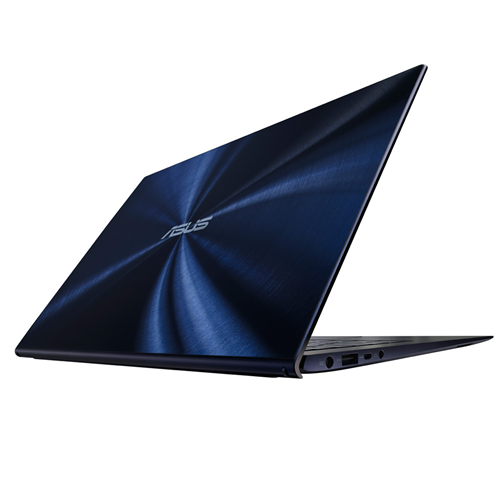
say resembled rippling water. Here the same effect is generated not in
aluminum, but but under a Gorilla Glass 3 lid, over a dark blue
background. The big difference between this and other recent slim
ultrabook-style laptops we've tested is the incredibly high gloss finish
on the back of the lid -- as one would expect from a glass top layer.
At a
bit over 3 pounds, the UX301 feels hefty in the hand, solidly built,
but not as light as some other 13-inch laptops. However, despite the
generally tight-feeling chassis, a very minor bump onto a carpeted floor
left the power pin from the AC adaptor seriously bent out of shape,
although still functional. That's why Apple, for example, has a magnetic
power connection (although I've dropped and bumped plenty of Windows
laptops over the years with nary a bent power plug pin). The matte
black interior features a sunken keyboard with large island-style keys.
Important keys such as Shift, Enter, and Backspace are decently sized,
and the entire keyboard has a very MacBook-like vibe, from the layout of
the arrow keys to the power button at the very top right corner. Typing
was only slightly hindered by some keyboard flex around the center, but
you'll have to be a heavy typist to really notice. The
large clickpad-style touch pad is much better than the versions found
on the early Zenbooks of years ago. Back then, touchpad response was
finicky, and multi-touch gestures were near-useless. This version is as
good as any Windows laptop, with quick response and natural-feeling
inertial scrolling, but I had to turn off the Windows 8 edge gestures because they were too easy to accidentally trigger. The
13.3-inch 2,560x1,440 touch screen display is a system highlight.
Covered with edge-to-edge glass, the touch response was excellent and
off-axis viewing was decent, but not best-in-class. The ultra-high
resolution allows for an amazing level of zoom, and you can
pinch-to-zoom on pages of text to see the effect up close. The glossy
screen does, however, have a lot of glare under normal lighting
conditions, so you may end up twisting and turning to find a glare-free
angle. The speakers are from Bang & Olufsen ICEpower, a
subsidiary of the famous audio company, and sound decent for such a
small laptop, although that may be because they're fired from side-edge
speakers, which gives you an especially wide stereo image.
Touch
Technology with a human touch
Zenbook UX301 is wonderfully tactile, but
that goes well beyond just the feel of its sleek, smooth and durable
glass design. Windows 8 is designed with touch in mind and a dedicated
ASUS Human Computer Interface team help make it even more intuitive to
use with features like a responsive multi-touch display, and a large
touch pad with multi-touch support. The backlit keyboard with automatic
brightness control also means you'll always have a clear view of the
keys, so you can stay productive, even in complete darkness. So
whichever way you like to work, Zenbook UX301 has you covered.
10-POINT CAPACITIVE MULTI-TOUCH DISPLAY
Touch is such an intuitive way to
interact with a computer display, we've been trying to do it for decades
— just ask anyone who sells screen-cleaning kits. The good news is that
with Zenbook UX301, reaching out to touch the screen is no longer an
empty gesture. Its 13.3-inch multi-touch display responds to the
slightest touch in just 30ms, so you can tap an icon to open an app,
pinch a web page to make the text larger, and swipe across the screen to
switch between running applications instantly. Multi-touch makes
everything so much easier.
The power and performance you need
Zenbook UX301 is a high-performance
Ultrabook™ in every sense. A 4th generation Intel® Core™ i7 processor
with Intel Iris™ 5100 graphics make light work of the most demanding
tasks, and keeps you entertained with your favorite games and HD video,
even when you're on the move. Solid-state storage means applications
launch in double-quick time and, together with Super Hybrid Engine II
technology, boosts battery life and standby time to stretch out the time
between recharges. Two USB 3.0 ports support the latest high-speed
storage and recharge mobile devices in double-quick time, while
sophisticated thermal management means Zenbook UX301 never loses its
cool.
Portable power and performance
Zenbook UX301 is powered by 4th
generation Intel® Core™ i7 processors for seamless multi-tasking
performance and outstanding energy efficiency. A high-end 28W Core
i7-4558U dual-core option makes light work of even the most demanding
applications. Intel® Turbo Boost Technology gives a burst of extra speed
up to 3GHz when you really need it, while Intel® HD Graphics 5100 with
Clear Video HD technology gives silky smooth playback with Full HD
video.
Work all day on a single charge
Energy-efficient components like the
Intel® Core™ processor and solid-state drive help Zenbook UX301 last for
up to 8 hours on battery power, so you can get a full day's work done
before you need to recharge. Exclusive Super Hybrid Technology can also
boost battery life by up to 25% for less demanding tasks like web
browsing and watching video, so you can last even longer between trips
to the power socket.
Always ready when you are
No one should have to wait when they want
to get something done, which is why Zenbook UX301 wakes from standby in
just two seconds. Exclusive Super Hybrid Engine II technology gives up
to two weeks' standby time too, and automatically saves all open
applications and data to the solid-state drive when the battery drops
below 5% charge level gets too low. So you don't have to worry about
always leaving Zenbook Touch plugged into a power socket just because
you're not using it.
USB 3.0, the next-generation connection for faster data transfers
USB 3.0 is ten times faster than USB 2.0
and with two ports at your disposal, you can save photos, transfer MP3s
and open multi-gigabyte video files in a fraction of the time with
compatible storage. USB 3.0 has more power for mobile devices, too.
Smartphones and tablets recharge in half the time compared to USB 2.0,
even when Zenbook UX301 is switched off. USB Charger+ technology lets
you charge your devices on-the-go.
Audio
The UX301LA's headphone-microphone combo jack offers satisfactory power,
a succinct stereo image and no interference or background noise.
The speakers are no miracle-workers, but they'll get you through a
videoconference just fine. Just know that (as usual with ultrabooks) any
music you listen to will be reduced to the middle of the spectrum with
little-to-no bass or high-end.
Processing Power
The Intel Core i7-4558U dual-core processor ranges from 2.8 GHz to 3.3
GHz, placing it just ahead of the Core i7-4500U dual-core (1.8 GHz to 3
GHz).
This gives it an average performance about 5% faster than the i7-4500U
found in the Dell Inspiron 14 7000 Series, and about 19% faster than the
i5-4200U that equips the Lenovo IdeaPad Yoga 2 Pro.
That said, it's still a ways behind quad-core processors like the
i7-4700MQ, which is 20% faster on average. But in terms of everyday
usage, it's a highly capable chipset that can handle any type of task in
a reasonable span of time.
Gaming
One unique thing about the Core i7-4558U is that it has an Iris 5100
graphics chipset. This GPU has 40 processing units, which is twice as
much as the HD Graphics 4400 found in many similar ultrabooks, so we
were expecting better gaming performance on it.
Unfortunately, despite having twice as many processing units, it only
performs 10% to 15% better. It's still a night-and-day difference with a
dedicated graphics card, even a mid-range one like the Nvidia GeForce
GT 740M (40% better performance).
You can still play some recent titles, as long as they're ones that don't require much graphics processing power, such as FIFA 13 or Dirt 3,
but even then you'll have to lower the screen resolution in order to
get fluid gameplay. That said, it plays HD videos without a problem.
Battery Life
The UX301LA held out 6 hours and 15 minutes during our battery test of
continuous video playback in airplane mode with the screen brightness at
100 cd/m², headphones plugged in and the keyboard backlighting turned
off. That's excellent battery life (although, of course, the 13" MacBook Air and Sony Vaio Duo 13 last even longer).
Models, specs & options
Asus is offering a number of different configurations and options for the Zenbook Infinity UX301LA:
CPU
2.8-GHz Intel Core i7-4558U
Operating System
Windows 8 Professional
RAM
8GB
RAM Upgradable to
Hard Drive Size
Dual 128GB
Hard Drive Speed
n/a
Hard Drive Type
Dual SSDs
Secondary Hard Drive Size
Secondary Hard Drive Speed
Secondary Hard Drive Type
Display Size
13.3
Native Resolution
2560 x 1440
Optical Drive
None
Optical Drive Speed
n/a
Graphics Card
Intel HD Graphics 5100
Video Memory
Wi-Fi
802.11ac
Wi-Fi Model
Intel Dual Band Wireless-AC 7260
Bluetooth
Bluetooth 4.0
Mobile Broadband
Touchpad Size
3.9 x 2.6 inches
Ports (excluding USB)
Headphone; Mini DisplayPort; Mini HDMI; USB 3.0
USB Ports
2
Card Slots
SD memory reader
Warranty/Support
1-Year International/1-Year Accidental Damage/30-Day Zero Bright Dot/2-way FREE shipping/24-7 tech support
The GoodThe
Asus Zenbook UX301 packs in a lot, including a better-than-HD touch
screen, big 256GB SSD, and Core i7 processor, in a slim, smart design.
The BadIt
costs more than most comparable better-then-HD laptops, including the
Retina MacBook Pro. The Zenbook doesn't feel as rugged as its price
warrants, and its battery life is unimpressive.
The Bottom LineAsus
was one of the first PC makers to go ultra-thin with its Zenbook line.
That latest UX301 version packs in nearly every high-end spec you'd
want, but it's priced out of reach for most, and lacks an all-day
battery.


 You won't be using that charger much.