It’s an iPhone 6 leak type of weekend - our inbox was buried with all sorts of tips about Apple’s upcoming smartphone.
After getting compared to the iPhone 5s and the Galaxy S5, the iPhone
6 now sits besides the iPod touch. These alleged comparison shots make
the design cues the new smartphone model takes from its music player
cousin all the more obvious. Alleged iPhone 6 prototype and iPod touch
Additional iPhone 5s / 6 comparison shots made their way out of China
along with dimensions - 138 x 67 x 7mm. That’s considerably larger than
the 135.3 x 71.9 x 6.1mm we estimated from the earlier leak. iPhone 6 prototype next to iPhone 5s
Keep in mind that this new iPhone is said to have a 4.7” screen, accounting for the larger size.
Apple security in China seems to have really broken down as an iPhone
6 dummy was photographed all around a city. Note that this could also
be an upcoming knockoff of the iPhone 6 (remember the iploxe?).
You can see all photos of the city tour at the Moscoat forum,
but these in particular caught our eye. First off, the iPhone 6 gets
dunked in water - either because it will be water resistant or because
this is a non-working dummy - and then it gets sized up against the
iPhone 5s and HTC One (M8). Alleged iPhone 6 prototype around town and under water
Do notice that this is the black color option with the gold ring home button we saw yesterday. Thanks to everyone for all the tips!
The Apple iPhone 6 rumor mill is getting busier by the week with rumors flying around pointing to display sizes, sapphire coatings and a number of dummy units and panels hinting at the design of the device.
The latest leak shows a new Apple iPhone 6 dummy only this time it
comes in the Gold color, complete with a golden accent around the Touch
ID home button.
The dummies come in Space Gray, Gold and Silver and look to carry an
HTC-like unibody. The back is interesting as it appears to have a
smaller camera lens - or perhaps it only appears smaller on a bigger
iPhone body.
It's unlikely that these dummies represent an exact replica of what
Apple plans to unveil this summer but are interesting to look at even
for the sole purpose of giving us an alternate idea to what is currently
the iPhone.
Currently rumors suggest the 4.7" iPhone 6 could arrive as early as August.
The iPhone 5C is kinda, sorta, technically a new product -- colorful,
cute, with a variety of interchangeable color cases much like the
recently released Motorola Moto X -- but under the hood it's really an iPhone 5 with a new paint job, and a cheaper price: $99 on contract (or even less, if you shop around).
To be clear, we loved the iPhone 5 when it first hit in 2012. It met
every one of our needs, kept up with the competition, and presented a
sweet spot of features: fast LTE wireless, a larger 4-inch screen,
plenty of performance tweaks, a faster processor, and a really great
camera. All of those features are back with the 5C.
The only new additions to the 5C (versus the old 5) are iOS 7
coming preinstalled, new LTE antennas that work with more international
carriers, a better low-light-sensitive front-facing FaceTime HD camera,
and a slightly increased internal battery versus last year's model --
better on paper, but not on a magnitude that most people would
appreciate.
What the iPhone 5C isn't is a radical "budget" iPhone. It's not
the affordable contract-free prepaid device some dreamed of. Instead,
it's an iPhone 5 with a candy-colored polycarbonate shell. If you want
something more advanced under the hood, the iPhone 5S is what you're looking for; if you want a bigger screen, nearly any Android phone will be a better choice.
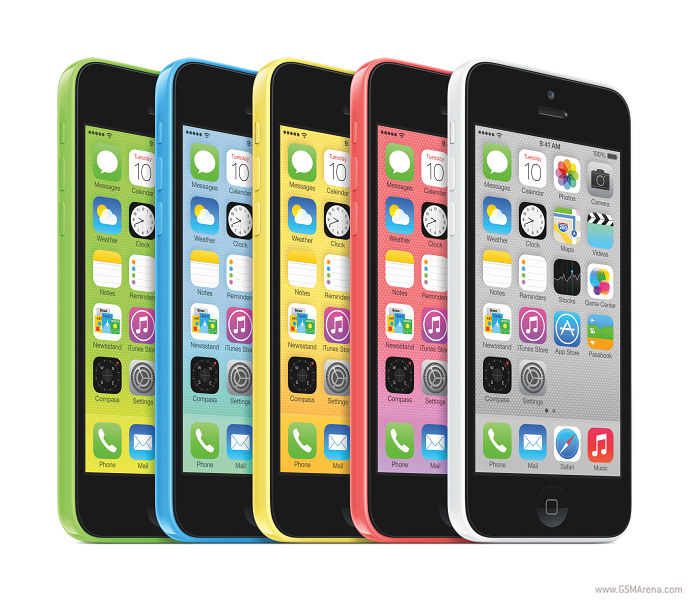
The polycarbonate exterior comes in a range of colourful
options - green, yellow, pink, blue and white - and anyone who has owned
an iPod will be well versed in these hues. This is the first time we've seen the varied palette make it to the iPhone range however, prompting some mocking from Nokia
who drew comparisons between the 5C and its fluorescent Lumia range -
and to be fair there is a small similarity between it and the Lumia 625 front on.
The
bright colours also make the iPhone 5C look a bit childish. Our green
review handset for example could be mistaken for a toy phone from a
distance and it doesn't exactly ooze the Apple quality we're used to
seeing when unboxing an iPhone.
However, look beyond that
and the iPhone 5C does feel structurally sound in the hand, no doubt
helped by the steel frame hidden under the polycarbonate exterior and we
found we were far less concerned about it smashing. The
steel frame also doubles as the 5C's antenna, meaning there's no risk
of signal dropping if you fancy holding this iPhone in your left hand.
While the likes of the iPhone 5S and iPhone 5
are clad front and back in glass causing users to be wary at all times
about the state of their smartphone, the iPhone 5C feels like it can be
chucked into a bag without us having to worry about its condition when
it comes to pulling it back out.
It's reassuring that the
iPhone 5C feels like it is capable of taking a few knocks, because the
slick, unibody plastic finish offers very little in the way of grip. Apple
does offer a range of equally colourful rubberised skins which you can
slap onto your iPhone 5C to provide some much needed additional grip,
but at £25 ($29, AU$39) a pop it's yet more money leaving your wallet -
plus the odd hole design of these cases won't be to everyone's taste.
Of
course third party accessory manufacturers will be falling over
themselves to offer a multitude of cases, skins and other forms of
protection for your iPhone 5C, so you'll be able to find cheaper
alternatives out there.
At 124.4 x 59.2 x 8.97mm the
iPhone 5C is slightly chunkier than the handset it's replacing, but
considering the iPhone 5 was wafer thin the 5C certainly isn't
overbearing in the hand and the added weight from a slightly larger
battery means that it actually feels more substantial compared to the
iPhone 5S.
The same minimalist attitude to buttons has been implemented
on the iPhone 5C, with the famous home key the only navigational aid on
the front of the device, while the power/lock resides at the top and
the separated volume keys on the left.
Just above the
volume keys is the small switch which is now synonymous with Apple's
iDevice range, allowing you to quickly toggle silent/volume mode.
All
the keys are easy enough to reach when holding the iPhone 5C in one
hand, but thanks to the elongated nature of the device since Apple
bumped the screen size up from 3.5 inches to 4 you need to stretch your
fingers that extra bit to reach the power/lock button. We'd
much prefer this key to be located on the right hand side of the iPhone
5C, as it would make it that bit easier to access and avoids any
awkward shuffling of the phone in the hand - but of course that would
see Apple copying Samsung in terms of placement, and nobody wants to see
any more accusations of copying coming along.
There's
nothing else joining the power/lock key on top of the 5C after Apple
relocated the headphone jack to the bottom with the iPhone 5 - a move which isn't to everyone's taste.
Joining
the left aligned headphone jack on the base of the iPhone 5C is a
centralised lightning port and a mono speaker to one side to help you
blast your tunes at grannies on the bus or conduct a more civilised
speakerphone conversation. Now
the right hand side hasn't been left completely alone on the 5C, with
Apple choosing this surface as the location for the SIM card tray - but
unlike most smartphones that take microSIMs these days, iPhones now rock
the tiny nanoSIM technology.
This means you'll have to
talk to your network about getting a nanoSIM for your shiny new iPhone
5C before you'll be able to use it - that is unless you're upgrading
from an iPhone 5, but we'd suggest that's pretty much a waste of money.
If
you're coming from a similarly priced Android handset you'll probably
think the iPhone 5C feels a little on the small size, with its 4-inch
display more at home at the budget end of the rival OS's line up. While
the screen size might not be anything special, the 1136 x 640 Retina
display is present and correct on the iPhone 5C, meaning it has the same
offering as both the iPhone 5 and 5S.
There are even
more similarities with the iPhone 5, as you'll find the same A6
processor, 8MP rear camera, 1.9 MP front camera, Wi-Fi and Bluetooth 4.0
in the 5C.
The iPhone 5C is 4G
enabled of course, but more supports even more bands meaning it'll work
even more networks around the world - Apple claims the 5C and the 5S
support the widest range of 4G bands out of any smartphone currently on
the market.
So what have we got so far then? Well, the
iPhone 5C is a slightly overweight iPhone 5 with a plastic body, larger
battery and a slightly lower price tag. If anything it looks to be a bit
of a hard sell on paper - but with iOS 7 on board, there's a litany of
places where it might it might excel.
What do you give up over the 5S?
This is the question everyone's going to ask: what am I missing out on
between the iPhone 5C and 5S for that extra hundred dollars? For
starters, the 5S has that crisp metal design. It also has a newer,
faster A7 processor, a fingerprint-sensing Home button, an even better
camera with faster autofocus, burst shooting, better low-light and
antiblur features, and a Slow-Mo video recording mode that records at
120 frames per second at 720p. What's more, the 5S is capable of 64-bit
computing, has better graphics, and has an M7 processor for enabling
future built-in motion-tracking and health/fitness apps. And it's also
available in a 64GB capacity, versus just 16GB or 32GB for the 5C.
CNET staff
A lot of those features are theoretical, or embedded so deeply the
casual person wouldn't notice. The 5C and 5S have the same screen size
and Retina resolution, and the same LTE antenna bands. Those are
features most people will notice a lot more. The 5C, from an everyday
boot-up, application-loading standpoint, feels similar to the 5S. That
said, I wouldn't be surprised to see the phones' speed begin to diverge
as the months and years progress -- once more advanced apps begin to
appear that are optimized for the more sophisticated hardware of the 5S.
Sarah Tew/CNET
Case and accessories
A new design means new cases: Apple's selling its own, at $29 each, in a
variety of bright colors, made of the same polyurethane/microfiber
material as the iPad Smart Covers and Smart Cases. The bright cases are
attractive; they're punched with large holes, so the iPhone's colors and
the case colors play off each other for color combinations. You can
only imagine third-party case manufacturers are going to be all over
this type of idea.
CNET staff
Apple's own cases are comfy, but oddly designed: the open holes expose
some of the stamped FCC and model information on the back of the iPhone.
Peeking at bits of text ruins a bit of the ultra-clean effect. Why not
shift those holes higher up, or place the text elsewhere? It's nitpicky,
but Apple's design usually prides itself on these sorts of details.
Display and speakers
The iPhone 5C's 4-inch, 1,136x640-pixel Retina Display seems every bit
as bright and crisp as on the iPhone 5. But, it's also the same exact
display: no extra pixel resolution, no added screen size. In a world of
ever-larger smartphones, the iPhone 5C is more on its own now than it
would have been in 2012. There's a lot of extra unused space above and
below the screen.
CNET staff
That being said, Apple's iPhone 5 Retina Display remains one of the
brightest and most color-accurate displays CNET's tested. It's an
excellent display, and has very good 326 ppi pixel density. It could
just be...well, a little bigger. There are 4.3- and 4.7-inch-display
Android phones that don't feel honkingly large to hold, and perhaps show
how Apple could have worked in a little extra screen.
CNET staff
A single speaker to the right of the Lightning port pumps out
equivalently loud audio to the iPhone 5. Just like previous iPhones,
it's possible to accidentally bottle up all noise by pressing a thumb to
the speaker grille while playing a game or watching a movie.
Camera
The same iSight rear-facing 8-megapixel camera that was in the iPhone 5
is in the 5C. iOS 7 adds a few more extras, such as digital zoom when
recording video. Both 1080p video recording, photos and panoramic
pictures all look great, but the iPhone 5S camera is even more refined,
and adds slow-motion recording and multiburst.
CNET staff
A front-facing FaceTime HD camera has been slightly improved, adding
better light sensitivity. Dimly lit selfies in my apartment hallway came
out better on the 5C.
Are there better cameras on phones? Absolutely. However, at this price range, the iPhone 5 still does a very, very good job.
Antenna and wireless connectivity
The iPhone 5C has dual-band 802.11 a/b/g/n Wi-Fi, just like the iPhone
5, along with Bluetooth 4.0. Apple's AirDrop technology in iOS 7 allows
for local file sharing, perhaps minimizing the omission of NFC in the
iPhone, but it's worth noting that NFC still isn't in any Apple device.
Both the iPhone 5C and 5S also lack faster 802.11ac Wi-Fi, which has
been introduced in many products, including 2013 MacBook Airs and
AirPort routers. Also, note that like the iPhone 5, the CDMA iPhone 5C
(so, the Verizon and Sprint versions) do not support simultaneous voice
and data.
Sarah Tew/CNET
Key features
Quad-band GSM and 3G support with 21 Mbps HSDPA and 5.76 Mbps HSUPA
LTE support where carriers support it and CDMA support when sold by CDMA carriers
4" 16M-color LED-backlit IPS TFT capacitive touchscreen of 640 x 1136px resolution
1.3 GHz dual-core Apple Swift CPU, PowerVR SGX543MP3 GPU, 1GB of LPDDR2 RAM, Apple A6 SoC
iOS 7 with iCloud integration
8 MP autofocus camera with LED flash and touch focus
1080p video recording at 30fps
1.2MP secondary front-facing camera
Wi-Fi 802.11 a/b/g/n, Wi-Fi hotspot
Bluetooth 4.0 LE, AirDrop file transfer and sharing between iOS 7-running devices
GPS with A-GPS connectivity; digital compass
16/32 GB storage options
Accelerometer, proximity sensor and a three-axis gyro sensor
Active noise cancellation with a dedicated secondary microphone
Standard 3.5 mm audio jack
Excellent audio output quality
Apple Maps with free voice-guided navigation in 56 countries
Voice recognition, Siri virtual assistant
Supports HD Voice (with carrier support)
FaceTime video calls over Wi-Fi and cellular
Free iWorks office suite
Free iMovie and iPhoto apps
Main disadvantages
Slippery glossy plastics prone to scratches and fingerprints
Thicker and heavier than the iPhone 5
Proprietary connector
No FM radio
No stereo speakers, feeble loudspeaker
No expandable storage
Stuck with iTunes for loading content
Mono audio recording in videos
Non user-replaceable battery
The 7th iOS iteration brought a long overdue UI overhaul to the
iPhone lineup, with Apple keen to demonstrate that the innovation well
hasn't dried up. Flat, colorful and with a ton of new features, iOS 7
certainly puts the iPhone 5c in a better position in the smartphone
race. Apple is also sweetening the pot even further by giving you the
complete iWorks office package, the iMovie video editor and the powerful
iPhoto app for free - content that otherwise costs more than $40. Apple iPhone 5c live pictures
Pricing remains the elephant in the room regarding the iPhone 5c, as
it slides in just $100/€100 below the iPhone 5s. That's as much as the
iPhone 5 would've cost had it not been discontinued and we have yet to
see if this is a change for the better or worse. On one hand you are
getting a fresh new design instead of one that's been around for almost a
year, but on the other, you are losing the premium metal body while
still paying the same price.
The high asking price also sends the iPhone 5c right in the way of
the current Android and Windows Phone top-dogs, pushing its (now
one-year-old) internals to the limit to keep up. It's certainly a
curious starting point and we are excited to see how the iPhone 5c race
develops. The unboxing and hardware tour is right after the break.
iOS 7
As well as sporting an all new form factor the iPhone 5C
also sees the arrival of Apple's latest edition of it mobile platform,
dubbed iOS 7.
Announced back in June 2013 at WWDC, iOS 7 actually made its way onto the likes of the iPhone 5 and 4S
a couple of days before the 5C went on sale, but along with the iPhone
5S they are the first handsets to actually ship with the new operating
system.
iOS
7 is arguably the biggest overhaul Apple has given its mobile software
since its inception in 2007, and in this post-Jobs era the design was
left up to Jony Ive.
If anything iOS 7 suits the
colourfully clad iPhone 5C more than the iPhone 5S which sports three
rather muted shades of grey, more grey and gold - and when you fire up
you're new 5C you'll note Apple has already set up a colour-matched
background to tie the whole package together.
Of course
we've already seen this colour trickery on Windows Phone devices where
the live tiles of the homescreen are set to match the colour of the
handset - and it's a nice touch which makes the hardware and software
feel more connected.
Starting at the lockscreen and
you'll immediately realise the iPhone 5C is running a new version of
iOS, with the famous slide-to-unlocked bar replaced with a simple text
prompt. It's a far more understated approach and if you
have a pin set up - there's no Touch ID fingerprint scan here - then the
swipe will take you to a numeric keypad which demands your secret
combination before allowing you access to the handset.
There's
also a camera app quick launch option on the lock screen in the bottom
right corner. Just place your finger on the camera icon and drag up to
launch yourself straight into the redesigned application.
If
you're coming from an Android handset you may be disappointed to find
Apple hasn't implemented more quick launches on the lockscreen - you'll
have to go through the unlock routine to access anything else.
Once
you are past that stage you're taken to the homescreen which is still
just the first page of your app list, with the same side scrolling
motion required to flip through the pages.
Your standard
options of dragging and dropping apps onto one another to create folders
and the pull down notification bar persists, although with some slight
updates. The notification bar has been tweaked by Apple and now includes three tabs in the pull down panel; today, all and missed.
By
default you're shown the "Today" tab, which displays the weather,
reminders, any calendar entries for the day and stock information.
Scrolling
down a bit more and there's also a bar which gives you a quick overview
of what exciting events or meetings you have planned for the next day.
Tap
"All" and you'll be able to view all your notifications from missed
calls, text messages and emails to social media and app alerts -
skipping across to "Missed" will just show you things such as missed
calls or Facebook conversations you need to catch up on.
You
can adjust what is displayed in the notification bar by diving into
settings, so if you couldn't care less about stocks, or are getting
irritated about how popular you are on Twitter you can turn off
individual settings.
Something which is completely new on
iOS 7 is the Control Center, accessed by swiping up from the bottom of
the screen on the iPhone 5C. This is a welcome addition
to iOS as Control Center provides you with quick settings for Wi-Fi,
Bluetooth, airplane mode, do not disturb and rotation.
There's
also a screen brightness bar, music controls, Air Drop shortcuts and
quick launch icons for the torch (using the LED on the rear of the
iPhone 5C), timer, calculator and camera apps.
You can
access the Control Center while in any menu or application, making it a
really useful feature to have if you quickly want to toggle something as
you don't have to leave the page you're viewing.
Both
the Notification Bar and Control Center can be accessed from the lock
screen, although if you fear this will give too much control to outside
users you can disable both - forcing a pin to be entered before being
able to get to them.
We found iOS 6
ran seamlessly on the iPhone 5, which had the same processor as the
iPhone 5C and iOS 7 is just as smooth here. Upgrade an iPhone 5 to iOS 7
and the on screen experience between the two will be almost impossible
to tell apart. The iPhone 5C may be seen as a cheaper
version of the iPhone franchise, but Apple hasn't skimped on the
internal grunt, giving you the same, high quality user experience you've
come to expect from the firm.
Multi-tasking
has been given an overhaul with iOS 7, and gone is the bar which
appeared at the bottom of the display when you double tap the home
button.
The double tap action now sees the screen you're
viewing minimised to a thumbnail in the centre of the screen, and a
horizontal list to the right of it made up of small panels of all the
other apps running in the background.
The layout reminds
us of the multitasking menu on HTC's Sense UI, and you can scrolling
through the various applications, swiping up over thumbnails to close
certain applications.
We're not overly keen on the new
design as the interface does break things up when flicking between apps,
where on the iPad you've got the great five finger swipe to move
between open apps – could this have not been repeated on the iPhone?
Apple
has continued to shy away from the calls of some for the introduction
of widgets into the iOS ecosystem, and while a couple of app icons
display live information - with the clock and calendar app sporting
relevant data - the majority are static images.
The
weather app suggests it's always sunny with a chance of cloud, while
the compass icon things we're always facing North North West.
It
would have been nice to see Apple make a few more of these icons
smarter, as we're pretty sure it's up to the job and going by the
slickness of the rest of the interface the processor could probably cope
with it too.
We found that the 4-inch screen was always
responsive to our various pokes and prods and the 1136 x 640 Retina
display provides clean and crisp visuals with a 326ppi pixel density.
That
does mean the screen on the iPhone 5C, on paper at least, doesn't match
the similarly priced, top Android and Windows Phone devices.
It's
not really an issue though as Apple's Retina technology still provides
an excellent display which is more than good enough on the smaller
4-inch screen size.
The viewing angles are still good on
the iPhone 5C and the display sits just under the glass, making it look
like it's actually printed on the glass instead of residing beneath it. Hold
the iPhone 5C next to a smartphone sporting a full HD display though
and you will notice it doesn't quite hit the same heights in terms of
clarity, but in isolation you won't be disappointed.
Opinion
on the new colour scheme for iOS 7 is still spilt, but the brighter,
fresher look certainly makes it look more enticing on screen, catching
your eye and actually pulling you into the operating system - where as
iOS 6 had become rather mundane.
What we do find
frustrating in iOS 7 and its previous iterations is the dependence it
has on the settings menu, with various app controls all housed here
instead of within the apps themselves.
It's annoying if
you're in the Facebook app for example and want to adjust the
notification settings, you have to exit the app and navigate to the
setting menu instead.
iOS 7 is a great improvement on the
previous version on Apple's interface and coupled with the colourful
iPhone 5C it makes for a pleasing package.
It runs
smoothly on the 5C and although some may take issue with the iOS 7
colour scheme, it's still easy to use with the addition of features such
as the Control Center provide a huge benefit to the end user.
Battery life
We're not sure what size battery the
iPhone 5C is hiding under that polycarbonate finish, but Apple assures
us it's a bigger offering than the iPhone 5 - and we're inclined to agree. In
short we've been pretty impressed with the battery performance on the
iPhone 5C, it only drops 3% to 4% overnight with various accounts
syncing throughout the downtime and with medium levels of usage it
comfortably saw out a day.
Overnight drain has haunted past iPhones, but it looks like Apple may have managed to resolve the issue with the 5C.
Apple
reckons you'll be able to eek out 10 hours video playback on the iPhone
5C or 40 hours of audio, the same as the iPhone 5, but these are best
case scenarios.
You'll still need to plug in and recharge
overnight, but if you're just using the phone for calls, texts, emails
and a bit of web browsing you won't be caught short.
Of
course if you fancy turning brightness up to full whack and then fire up
some power-intensive games you'll see that battery drain pretty
quickly, but the iPhone 5C still performs better here than the 5.
We
took the iPhone 5C for a spin as a sat nav - a process which usually
drains phone batteries in no time at all, but the two hour journey saw a
drop of 30%.
That's pretty good considering it was
constantly rendering maps, keeping a GPS lock, churning out voice
commands and still syncing our various accounts in the background
without the screen switching off.
The GoodThe iPhone 5C
is available for $99 or less on contract, and in five bright colors.
Compared with the 2012 iPhone 5, it’s got more widely compatible global
LTE coverage, an upgraded front-facing camera, and slightly better
battery life.
The BadThis
phone is 2012 tech dressed up in a brighter package for 2013; the
four-inch Retina Display feels small compared with most Android phones.
The Bottom LineThe iPhone 5C is a great $99 phone that basically replicates the well-reviewed iPhone 5 in a more colorful case.